
A deduction lowers the income you are taxed on, while a credit lowers the tax you owe after the rate is applied. That single distinction decides which claims are worth chasing on your Canadian return and which ones barely move your refund.
Key takeaways
- A tax deduction reduces taxable income, so its value follows your marginal rate. A non-refundable tax credit is calculated at the lowest federal rate, which is 14 percent in 2026.
- The federal basic personal amount for the 2025 tax year is $16,129 if your net income is $177,882 or less, and $14,538 once net income passes $253,414.
- Medical expenses are reduced by the lesser of 3 percent of net income or $2,834 for 2025, which is why small claims produce nothing.
- Refundable credits such as the Ontario Trillium Benefit and the GST/HST credit can pay you even when your tax owing is zero.
- For a Canadian-controlled private corporation, the federal small business rate is 9 percent and the Ontario lower rate is 3.2 percent on the first $500,000 of active business income.
What is the difference between a tax deduction and a tax credit?
Deductions come off your income before tax is calculated. If your combined marginal rate is 30 percent and you deduct $10,000 of RRSP contributions, you keep $3,000. The same $10,000 run through a federal non-refundable credit at the lowest rate of 14 percent is worth $1,400.
That is the whole reason we sort a client file into deductions first and credits second. Deductions are also what the Canada Revenue Agency looks at hardest during a review. They scale with income, so the dollars at stake are larger. Credits are more mechanical. You either qualify or you do not, and the amount is fixed by the rules for that year.
One more split matters. Non-refundable credits can bring your tax to zero and stop there. Refundable tax credits are paid out even when you owe nothing, which is why a student or a retiree with no tax payable should still file every year.
Deductions that change the number on Ontario returns
Registered savings do most of the work. The RRSP deduction limit for 2026 is $33,810, or 18 percent of your prior year earned income if that is lower. A TFSA contribution, capped at $7,000 for 2026, gives you no deduction at all, so the order you fund those two accounts is a real decision, not a preference.
Child care expenses are claimed on line 21400 and are normally deducted by the spouse with the lower net income. The annual limits depend on the age of the child. They are higher when the child qualifies for the disability amount. The total is also capped at two thirds of earned income. Moving expenses can be claimed when you move at least 40 kilometres closer to a new work or study location. The claim includes up to $5,000 of costs to maintain the old home while it sits vacant and on the market.
Then there are the quieter ones we still find on new client files. Annual union and professional dues go on line 21200. Carrying charges on investment loans qualify as well. Employment expenses go on line 22900 when your employer signs Form T2200. Salaried employees can no longer use the flat rate home office method from the pandemic years. A home office claim now needs the detailed calculation and a signed form.
Which credits do Mississauga filers leave on the table?

The basic personal amount is automatic. Most of the rest are not, and the ones below get missed year after year.
Credit (2025 tax year) | Federal amount | Line |
|---|---|---|
Basic personal amount | $16,129 (reduced to $14,538 at high income) | 30000 |
Canada employment amount | $1,471 maximum | 31260 |
Disability amount for self | $10,138, plus $5,914 if under 18 | 31600 |
Medical expenses | Total less 3 percent of net income or $2,834 | 33099 |
Home accessibility expenses | $20,000 per year of eligible work | 31285 |
Canada training credit | $250 added per year, $5,000 lifetime | 45350 |
The disability tax credit is the one with the longest tail. Approval on Form T2201 opens other doors. It can support the Canada caregiver credit for a family member, raise the child care limit, and allow adjustments to prior returns. Tuition amounts, student loan interest, the pension income amount and charitable donations round out the list we review on every personal file.
Medical expenses reward planning more than record keeping. You may pick any 12 month period ending in the tax year. A family that pays for orthodontics in November and physiotherapy the following August can group both into one claim. Details and the full eligible list are on the CRA page for lines 33099 and 33199.
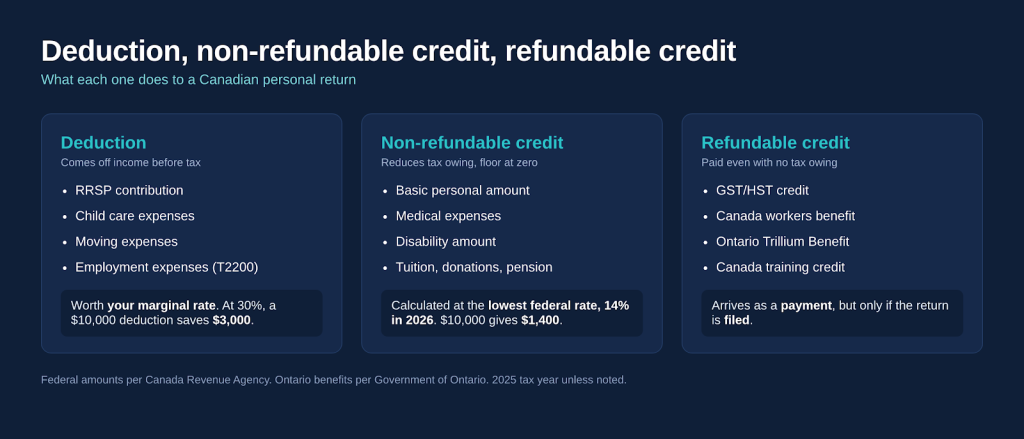
The three mechanisms behave differently once your tax owing hits zero.
Refundable credits and Ontario benefits paid through your return
Refundable tax credits are the reason a return with no tax owing is still worth filing on time. The GST/HST credit, the Canada workers benefit and the Canada child benefit are driven by the net income you report. None of them arrive if the return is late. The payments are recalculated each July from the return you filed that spring.
Ontario adds its own layer. The Ontario Trillium Benefit rolls three credits into one monthly payment: the Ontario energy and property tax credit, the Northern Ontario energy credit and the Ontario sales tax credit. You claim it on the ON-BEN form attached to your T1. Seniors who own a home may also qualify for the Ontario Senior Homeowners’ Property Tax Grant of up to $500. The province keeps the current list on its tax credits and benefits page.
The Canada child benefit deserves its own line in the plan. It is a monthly payment, not a credit on the return. The maximum you receive depends on the number of children, their age and the family net income you reported. A pension adjustment, child care claimed by the right spouse or any deduction that reduces net income can raise the benefit for a full year. That is often worth more than the tax saved on the return itself.
A practical note from files we see in Mississauga and across the GTA. Couples often file separately from each other’s information, then discover that the benefit calculation used the wrong household income. Filing both returns together, in the same session, is the cheapest fix there is.
Business deductions for the self-employed and incorporated
Unincorporated business income is reported on Form T2125, and the test for an expense is whether you incurred it to earn business income. Motor vehicle costs are prorated by business kilometres, which is why the logbook matters more than the receipts. Business use of home expenses go on line 9945, cannot create or increase a business loss, and any unused portion carries forward to the next fiscal period. The CRA sets out the full list of allowable business expenses for sole proprietors and partnerships.
Once you incorporate, the arithmetic changes. The federal net rate is 15 percent, dropping to 9 percent on active business income eligible for the small business deduction. Ontario applies 11.5 percent and a lower rate of 3.2 percent on the first $500,000. A corporation also opens the salary versus dividend question, capital cost allowance on equipment, and the timing of a bonus before year end.
Our Mississauga tax services cover both sides of that line. Fee ranges for T1, T2 and T3 filings sit on our pricing page.
Students, tuition and a first full time job
Students rarely pay much tax, so the value of their tuition fees is not the refund this year. It is the carry forward. Eligible tuition is reported from the T2202 the school issues. A capped portion can be transferred to a parent, grandparent or spouse. Everything else stays on file until the student has income to reduce. Interest paid on a government student loan qualifies for its own credit and can be carried forward five years.
The mistake we see most often is a student who does not file because there were no taxes payable. Nothing gets tracked, the amounts are not reported, and the family later discovers the transfer was never made. A return also registers the young adult for the GST/HST credit at age 19, so the missed filing costs quarterly payments as well.
The first full time job changes the picture again. Employment income brings the Canada employment amount. CPP and EI amounts appear as credits on the return. A first RRSP contribution can be reported now and deducted in a later, higher year. That timing choice is worth more than most people expect, and it costs nothing to make.
Registered plans, pension income and investment accounts
Registered accounts are where a deduction and a credit sit side by side. An RRSP contribution is a deduction that lowers taxable income in the year you claim it. A first home savings account works the same way. A TFSA does not, which is why the order you fund them matters. Money you put in a registered education savings plan for your children buys no deduction either. The federal grant paid into the plan is still real money you receive for saving. The age of the child decides how much room is usable.
Retired filers have their own set. The pension income amount is a maximum of $2,000 federally for 2025, and Ontario allows up to $1,762 on the provincial side of the same return. Couples can also allocate up to 50 percent of eligible pension income to a spouse or common law partner. That can reduce the taxes the household pays and protect income tested benefit payments.
Investment accounts matter for the timing, not the credit. Interest paid on money borrowed to earn investment income is deductible. Carrying fees charged by an adviser may qualify. Capital losses can be carried back three years against gains already reported. A larger refund next spring often comes from moving one of these into the right year rather than from finding a new claim.
Claims tied to a dependent family member
Support for a dependent relative is where federal and provincial rules stack. The Canada caregiver credit applies when a spouse, a child or another dependent adult relies on you because of an impairment. It can be claimed alongside the disability amount transferred from that person. Ontario runs its own parallel amounts, so the provincial side of your return often produces a second, smaller reduction on the same facts.
Two habits protect these claims. Keep the medical practitioner letter that describes the impairment and its duration. Keep proof of what you paid, including nursing fees, attendant care fees and the share of facility payments that qualifies. Families who plan together decide in advance who will receive the transfer. The other spouse then knows what is left to reduce their own taxes.
Amounts change every year with indexation. We check the current figures against the CRA tables before we file. A threshold that moved by a few hundred dollars can change which spouse should make the claim.
What does the CRA look at when it reviews a claim?
Most reviews are not audits. They are a letter asking you to support one number. Farrukh began his career as a Tax Auditor with the Canada Revenue Agency. The pattern he saw then still holds: a claim survives when the paperwork was built at the time of the expense, not reconstructed in the fall.
Three areas draw questions on personal returns. Vehicle and travel claims without a logbook. Medical claims where the 12 month period was chosen but not documented. Employment expenses filed without a signed T2200. On the business side, the recurring one is personal spending recorded as a business cost, which is the fastest way to have every other line looked at too.
Anyone can read our approach to tax audit defence work, and the profile of the person handling those files is on our about page.
Building next year’s claim before December
Deductions and credits are decided by things you do during the year, not by software in April. A plan set in October beats a scramble in April. Contribution room gets used before the RRSP deadline, and a donation receipt is dated before December 31. A T2200 requested while your manager still remembers the arrangement. An instalment paid on time, so interest does not eat the benefit.
Filing on time also keeps benefit payments flowing. We ask new clients for three things at the first meeting. Last year’s notice of assessment, the CRA My Account summary of unused amounts, and a list of anything that changed. Carried forward tuition, unused RRSP room and net capital losses are all sitting in that file. They are the easiest money in the process, because the CRA already tracked them for you.
Need a second read on what you can claim this year? Call us at (905) 814-0111 or book a complimentary strategy session.
Questions we get about deductions and credits
Are tax credits better than tax deductions?
Not automatically. A deduction is worth your marginal rate, so it beats a non-refundable credit at higher incomes. A refundable tax credit is the strongest of the three when your tax payable is already zero.
Can I claim medical expenses for my whole family?
Yes. Expenses for you, your spouse or common law partner and your children under 18 go on line 33099, and amounts for other dependants go on line 33199. The claim is normally made by the spouse with the lower net income, because the 3 percent threshold is smaller.
What happens if I forgot a credit on a past return?
You can request a change for the previous ten calendar years through My Account or Form T1-ADJ. We review the last three years for most new clients, since that is where unclaimed medical, tuition and disability amounts usually sit.
Do I still need to file if I had no income?
File anyway. The GST/HST credit, the Canada workers benefit, the Canada child benefit and the Ontario Trillium Benefit are all calculated from a filed return. Unused tuition only carries forward if it is reported.
Are home office costs still deductible for employees?
Only with the detailed method and a signed Form T2200 from your employer. The temporary flat rate option is gone, and the workspace has to be where you mainly work or a space used solely to earn employment income.